One thing that has bothered me for a long time about the cancer-alcohol link is the fact that many of us who are of a certain age began drinking in bars where people smoked.
Even if you never smoked in your life, I mean, like you’re such a square that you didn’t even try a cigarette (that includes this square, by the way) you would have been exposed to smoking.
That is an association that is difficult if not impossible to exclude from research using large population databases, because although they ask about lifestyle issues like “do you smoke?” they tend not to ask things as granular as “where have you been drinking over the past few decades?” (As if there is a way to answer that anyway)
This all just sort of sat in the back of my mind until I saw the following info graphic on the US Surgeon General’s advisory about cancer warning labels on alcohol containers:
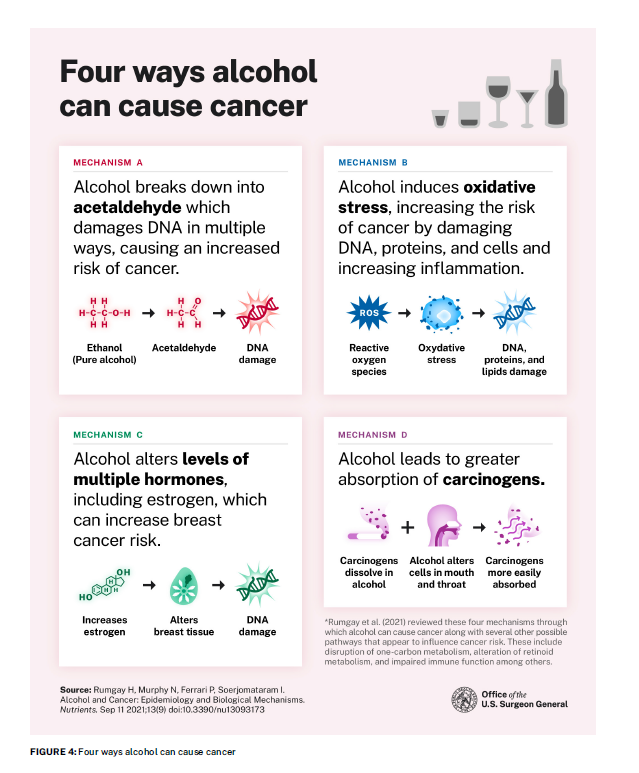
Check out Mechanism D: alcohol leads to greater absorption of carcinogens.
So those high levels of oral, pharynx, larynx, and maybe even esophagus cancers may be more about where people drank than the carcinogenicity of the booze. In other words, if you were drinking in a smoky bar alcohol caused you to absorb carcinogens.
It is not about alcohol as a carcinogen, but alcohol as a medium. And if you’re not drinking around smokers, that risk is much lower, but it would not yet be captured in longitudinal data because cancer often takes decades to manifest.
It will be interesting in 30 years–if anyone is still drinking–to see if these levels have changed, because most people drinking will not have been drinking around smokers.
I also want to point out the classic example of how zealous anti-alcohol advocates misrepresent how the liver metabolizes alcohol.
See Mechanism A: Yes, the liver breaks alcohol to acetaldehyde, and it is labeled a carcinogen.
But it’s not as if we are left with all this carcinogen sloshing through our bodies.
The liver then breaks acetaldehyde down into acetic acid (aka vinegar) which is not a carcinogen–it is in fact a food for cells.
They always seem to forget to mention that part.
I wonder why.
This is an evolved process. Our primate ancestors developed the ability to metabolize alcohol as a food source for their cells, which was especially valuable in times of food scarcity. Alcohol is a compact calorie source.
All this is not to say there is no risk of cancer from drinking but it does indicate how we need to be very to accept uncritically such distorted information because it is clearly leading us down a carcinogenic garden path. The risk, if at all, is much lower than often implied, and the benefits may be much greater than acknowledged.
Leave a Reply