My Publications
I have spent much of my career trying to understand how societies think about alcohol, drugs, risk, and regulation. My books and articles explore the people, institutions, activists, ideas, and conflicts that have shaped alcohol and drug policy and public health over the past two centuries.
Although these works are rooted in history, they are ultimately about the present. Questions about evidence, harm, responsibility, and regulation are rarely new, and many contemporary debates have surprisingly deep historical precedents. My publications aim to bring that longer perspective to discussions that are often framed as entirely modern problems.
Along the way, I have written about prohibition, public drinking, liquor control, addiction, pharmacy, temperance movements, public health, and the changing ways societies define and respond to risk.
By examining how earlier generations confronted similar questions, my work seeks to provide a broader perspective on some of today’s most contentious policy discussions.
Click on images to go to the publisher’s site
(In case you’re wondering why some books have more blurbs than others, older books have been reviewed and some reviews are included. Everything is taken from the publisher’s website)
Please don’t use bulk booksellers like Amazon. They rip off academic publishers.
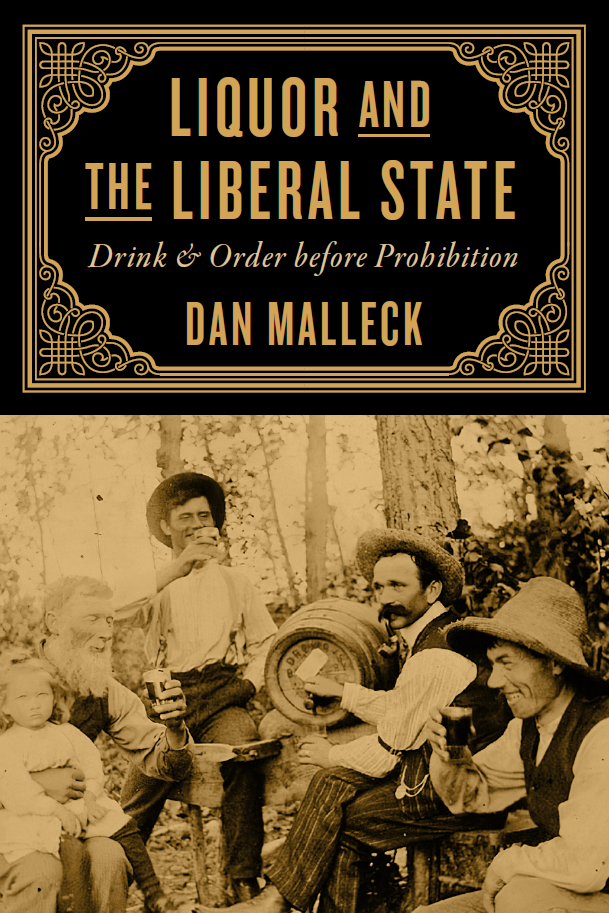
This finely crafted book is sure to stand the test of time. It is a profound addition to ongoing discussions of drink and order in Canada before prohibition. Matthew J. Bellamy, author of Brewed in the North: A History of Labatt’s
Dan Malleck strides across the huge complexities of the history of alcohol regulation in Ontario with confidence, wit, and keen insight. There is no other book like this one in the field. Craig Heron, author of Booze: A Distilled History
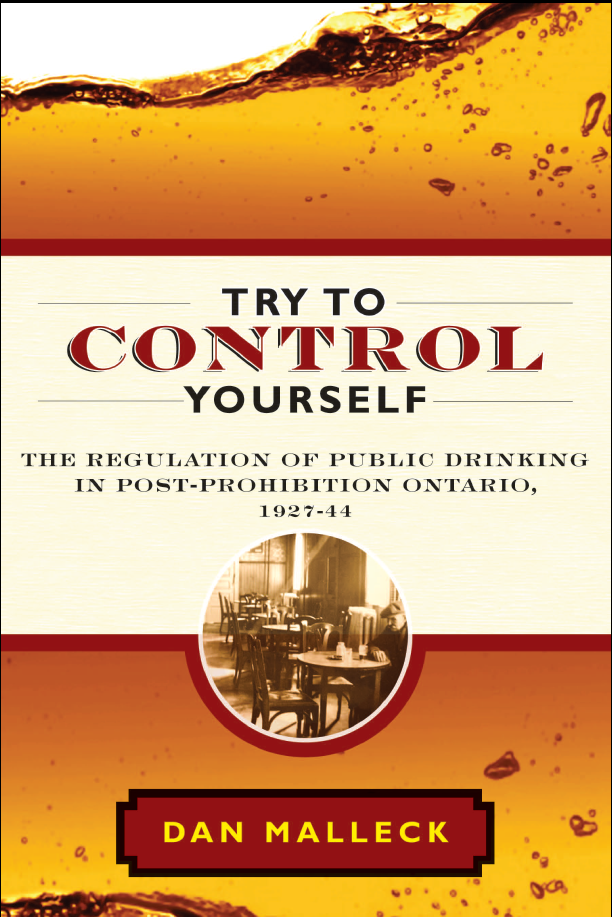
Winner of the 2012 Canadian Historical Association Clio prize for Ontario History
Try to Control Yourself is both an absorbing account of alcohol regulation in post-prohibition Ontario and a significant study of the relationship between bureaucracy, surveillance, and social order. Its meticulous research brings to life the work of the Liquor Control Board of Ontario and demonstrates how understanding the intricate realities of administrative activity can enhance critical debates about power and control. This detailed work shows how cultural values are tied to practices of government and, in doing so, offers important lessons for alcohol policy today.” James Nicholls, author of The Politics of Alcohol: A History of the Drink Question in England
This well-written history provides a rich and nuanced analysis of how the Liquor Control Board of Ontario responded to a divisive political problem in post-prohibition Ontario: to promote orderly but legal public drinking. It offers a sophisticated theoretical interplay between Foucault’s concept of biopower and Weber’s work on bureaucratization, revealing a variety of actors – the LCBO, inspectors, police, politicians, licence holders, patrons, pressure groups, and even bootleggers – all enveloped in a web of regulation whose strands, while created by the state, were not completely controlled by it. Robert Campbell, Dean of the Faculty of Arts and Sciences, Capilano University and author of Sit Down and Drink Your Beer: Regulating Vancouver’s Beer Parlours, 1925-1954
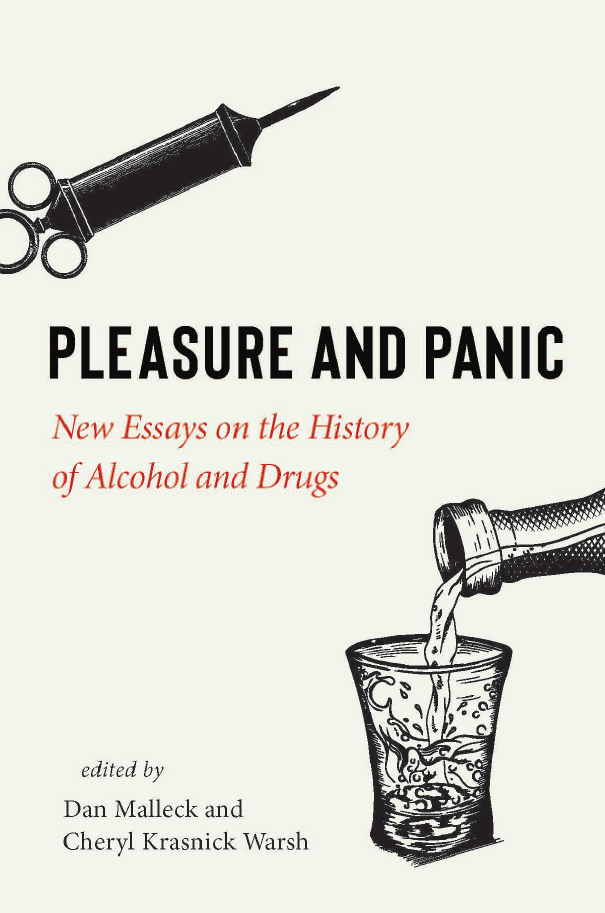
[Pleasure and Panic] is a compilation of fascinating studies that examine how the regulation and use of addictive substances have informed social movements, medical innovations, marketing, and even cultural identity. Dave Hazzan, Literary Review of Canada
Despite the primarily Canadian focus and origins of this collection, there is much here for anyone broadly interested in the history of intoxicants. David Adler, Bournemouth University, The Social History of Alcohol and Drugs
Taken together, this collection [of essays] provides a valuable ‘state of the field,’ especially with regards to the history of drugs and alcohol in the Canadian context. Catherine Carstairs, University of Guelph, Canadian Journal of Health History
Pleasure and Panic is a lively and consistently interesting set of essays illustrating the best that is being done today in the alcohol and drug history field. Ian Tyrrell, co-editor of Alcohol and Temperance in Modern History
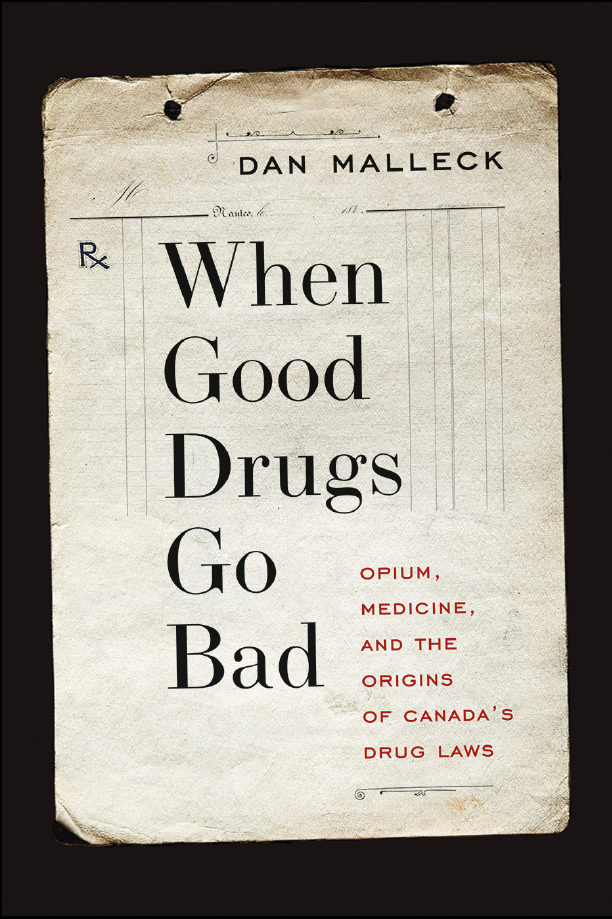
In Malleck’s brilliant account we can see how commercial interests both combined and competed with professionals and sellers to influence Canada’s drug laws … As Canadians debate how marijuana should be designated—legal or illegal, medicine or recreational drug or both—Malleck provides a fascinating description of a similar journey taken by pain medications such as opium and cocaine at the beginning of the last century. His book provides a useful history to help us navigate today’s discussions about who should grow and sell safe and affordable marijuana. Colleen Fuller, a researcher and writer focused on health and pharmaceutical policy, Alberta Views
[A] close study of how doctors, pharmacists, bureaucrats, and policy-makers wrestled over the control of opiates in the decades leading to the first Opium Act of 1908 … When Good Drugs Go Bad will be of interest to scholars exploring the history of drugs and their regulation while also adding to our understanding of state formation and professionalization during the nineteenth century. Its multi-regional focus on Quebec, Ontario, and British Columbia serves to nationalize these issues. Malleck also addresses and critically challenges the association in British Columbia between anti-Chinese sentiments and opium that, he argues, has distorted events by insisting that the Opium Act was a reaction to racial tensions. Instead, by broadening the regional lens, Malleck shifts the story to a contest over professional authority. Erika Dyck, BC Studies
[When Good Drugs Go Bad] is a well-written and well-researched book… Readers will learn much about the ‘awesome, awe-inspiring, and awful substance’ that was opium… Readers may also find that Malleck’s discussion of ‘danger’ and addiction fears with this drug in the nineteenth and early twentieth centuries resonates with today’s opioid debates. Shelley McKellar, University of Western Ontario, Pharmacy in History
When Good Drugs Go Bad will stand for a long time as an essential volume in every drug scholar’s library, not only for its encyclopedic detail and insightful analysis but for the sheer pleasure of reading Dan Malleck as he recounts the history of drug regulation in Canada. Joseph Spillane, co-author of Federal Drug Control: The Evolution of Policy and Practice
This collection captures key themes and issues in the broad history of addiction and vice in the Anglo-American world. Focusing on the long nineteenth-century, the volumes consider how scientific, social, and cultural experiences with drugs, alcohol, addiction, gambling, and prostitution varied around the world. What might be considered vice, or addiction could be interpreted in various ways, through various lenses, and such activities were interpreted differently depending upon the observer: the medical practitioner; the evangelical missionary; the thrill seeking bon-vivant, and the concerned government commissioner, to name but a few. For example, opium addiction in middle class households resulting from medical treatment was judged much differently than Chinese opium smoking by those in poverty or poor living conditions in North American work camps on the west coast, or on the streets of East London.
This collection will assemble key documents representing both the official and general view of these various activities, providing readers with a cross section of interpretations and a solid grounding in the material that shaped policy change, cultural interpretation, and social action.
Note: this book was published with the intention of it being available to libraries. It’s prohibitively expensive for an individual purchaser.