One thing that has bothered me for a long time about the cancer-alcohol link is the fact that many of us who are of a certain age began drinking in bars where people smoked.
Even if you never smoked in your life, I mean, like you’re such a square that you didn’t even try a cigarette (that includes this square, by the way) you would have been exposed to smoking.
That is an association that is difficult if not impossible to exclude from research using large population databases, because although they ask about lifestyle issues like “do you smoke?” they tend not to ask things as granular as “where have you been drinking over the past few decades?” (As if there is a way to answer that anyway)
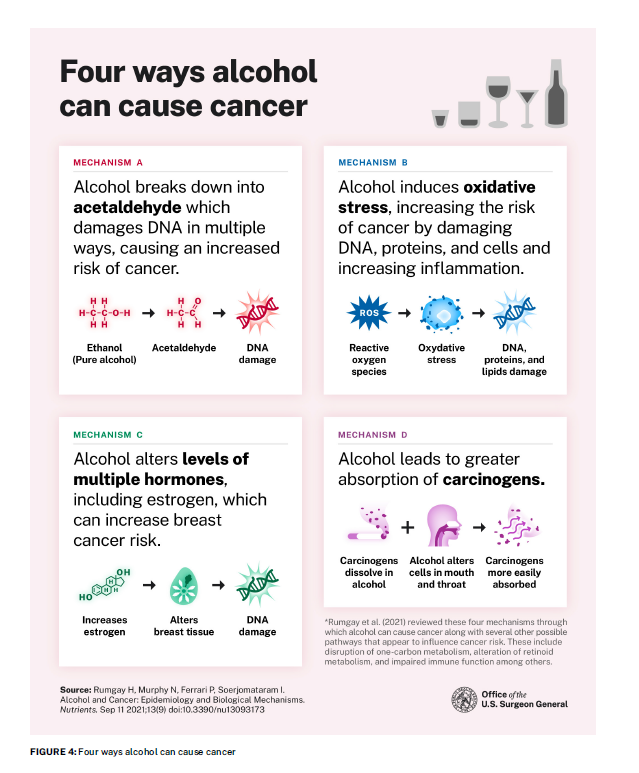
This all just sort of sat in the back of my mind until I saw the following info graphic on the US Surgeon General’s advisory about cancer warning labels on alcohol containers:
Check out Mechanism D: alcohol leads to greater absorption of carcinogens.
So those high levels of oral, pharynx, larynx, and maybe even esophagus cancers may be more about where people drank than the carcinogenicity of the booze. In other words, if you were drinking in a smoky bar alcohol caused you to absorb carcinogens.
It is not about alcohol as a carcinogen, but alcohol as a medium. And if you’re not drinking around smokers, that risk is much lower, but it would not yet be captured in longitudinal data because cancer often takes decades to manifest.
It will be interesting in 30 years–if anyone is still drinking–to see if these levels have changed, because most people drinking will not have been drinking around smokers.
I also want to point out the classic example of how zealous anti-alcohol advocates misrepresent how the liver metabolizes alcohol.
See Mechanism A: Yes, the liver breaks alcohol to acetaldehyde, and it is labeled a carcinogen.
But it’s not as if we are left with all this carcinogen sloshing through our bodies.
The liver then breaks acetaldehyde down into acetic acid (aka vinegar) which is not a carcinogen–it is in fact a food for cells.
They always seem to forget to mention that part.
I wonder why.
This is an evolved process. Our primate ancestors developed the ability to metabolize alcohol as a food source for their cells, which was especially valuable in times of food scarcity. Alcohol is a compact calorie source.
All this is not to say there is no risk of cancer from drinking but it does indicate how we need to be very to accept uncritically such distorted information because it is clearly leading us down a carcinogenic garden path. The risk, if at all, is much lower than often implied, and the benefits may be much greater than acknowledged.
In November 2025 I spoke to a committee of the Canadian Senate that was contemplating Bill S-202, which would mandate warning labels on alcohol containers.
I was on a panel that was supposed to be industry people, but I spoke as an independent citizen.
I’m not going to revisit that fun experience here, but wanted to refer to it because…. it’s BA-ACK
It’s currently going through its third reading . If it passes, it goes to the House of Commons
Given the current debatable state of research on cancer “causation” and alcohol, it is most definitely an excessive measure. I’d say go head put nutrition labels on booze (spirits are more harmful but lower calories so there is that issue), and if you need to, sure put standard drink amounts (although I think that can be productive of a certain discourse of control so misleading in itself).
But if you’re going to do cancer warnings, the information should be balanced against health benefits.
And I’m not talking about cardiovascular protective effects or the crazy protective effects vs diabetes. Believe it or not, some good research shows alcohol has protective effects vs. kidney, bladder, and lymphatic cancers. I’m not sure why that doesn’t come up in the [anti-]alcohol research, but I have my suspicions that it’s something to do with their perception of “the rigour” of the research.
If that is the case, here is something else to think about: the Yukon alcohol labelling study that so many people refer to as showing real impact of labels was terrible. It was cancelled early, it did not gather useful information, and it was designed to cover not even an entire year of purchasing data. That means you don’t track the ebbs and flows of purchasing patterns across a year. Since the study was cancelled in December or January, its data covers a specific purchasing pattern basically the binges up to New Years and the drying out pattern in January.
However, they published over a dozen research papers (mostly repetitive) which means when you do a search to research the effects of alcohol labels, their results show up. This eclipses better research on the limited effect of labelling in general and the problems with overly-restrictive labelling language.
Ironically, when Tim Stockwell was talking to Felicity Carter about his research, he kept referring to every study that contradicted or complicated his results as poorly done or bad studies. I guess he would know, because he was involved in the v Yukon labelling study.
(At this point someone would point out that the study was interrupted by the drinks industry, but that is a red herring that helps to demonstrate my point. The very fact that it was interrupted means that the study was weakened. The industry action made the study more visible, so you don’t get clean data when asking people if they noticed the labels. With the amount of exposure the study and controversy had in the media, people would be more likely to remember the labels–and one of the questions people were asked was whether they had noticed the labels. In other words, the integrity of a study that was already of questionable design was corrupted. But they still published a lot.)
Anyway, all this to say that the bill is heading to third reading.
I’ll be frank and note that I don’t really care how this affects the industry. The industry can look after itself.
I am most certainly concerned about how a limited and incomplete picture of health effects of drinking will affect everyday people who just want a drink unharassed by histrionic and narrowly focused information.
Recent discussions about alcohol and risk often repeat the mantra that “the science has changed.” This is especially apparent in the difference between the 2011 Canadian low risk drinking guidelines and the 2023 “Low Risk Drinking Guidance” from the Canadian Centre on Substance Use and Addiction (CCSA).
This is not an unreasonable thing to state, given that nearly a decade of research had been published between 2011 and when the research for the CCSA study was initiated in 2020. (Let’s just not get into how much of that research was done by the contributors to the 2023 report).
But even a cursory comparison of the two documents shows that it is not only the “science” that changed: it is the tone, moral positioning, cultural understanding of the place of alcohol in lives, and the underlying theme of the two reports.
Consider this: the 2011 report opens with a broad and (to a historian) valuable quote from Greek philosopher Eubulus (375BC):
Three cups do I mix for the temperate; one to health, which they empty first, the second to love and pleasure, the third to sleep. When this bowl is drunk up, wise guests go home. The fourth bowl is ours no longer, but belongs to violence; the fifth to uproar, the sixth to drunken revel, the seventh to black eyes, the eighth is the policeman’s, the ninth belongs to biliousness, and the tenth to insanity and the hurling of furniture.
(Quoted in Butt et al 2011 p12)
It’s a statement about the value of moderation versus the hazards of over consumption, and would have no place in the 2023 report.
The authors then proceed to acknowledge that different people drink different substances at different times, indicating for example that there is a regional variation in both quantity and substance consumed (Butt et al, 2011, pp18-19) and a consideration of the behaviour within physical locations where people consume, such as “bars, discos or taverns.. [versus] in a restaurant or at home” (p18).
They define different types of health outcomes (short term/acute; long term/chronic) and engage with the difference between mortality (something that kills you) and morbidity (something that harms you).
The 2011 study also recognizes difference:
Different people drink different amounts in different frequencies, with varying consequences for their health and safety. The amount drunk (or ‘dose’ consumed) on one drinking occasion will determine their subjective experience, physical reactions and how they behave, in accordance with blood alcohol concentration (BAC) achieved and individual tolerance to alcohol effects
(Butt et al 2011 p 16)
It’s as if they recognize that people consume alcohol differently, have different subjective experiences, and that any guidance needs to recognize this difference and address it.
The study even frames its results in a degree of uncertainty, which to me indicates respect for the reader. It includes a clear statement about the difference between relative risk and absolute risk (p 14) and it recognizes that “the quality of science… is as yet far from perfect” (p13) (which arguably every scientist should say about pretty most topics) but the CCSA (2023) document most certainly does not.
What is most striking though about the two studies is not the results of the research. Of course if the research “has changed” over a decade, you might expect different results.
What is instead most notable to me is the acknowledgement in the 2011 document that there are a range of variables to consider, and that drinking patterns are different for different people, in different locations, and at different times of their lives.
For example younger people are more likely to binge and therefore the risks of accidents is higher for them (pp 21-22), and the cardio-protective effects of alcohol don’t really seem to matter until people are older. That’s right, they do recognize and address cardio-protective effects (pp 26-27). In fact they make the remarkable admission that
an estimated 1,828 deaths from cancer (as well as several thousand other causes of death) could be attributed to alcohol use in 2002, while alcohol prevented an estimated 2,589 cardiovascular deaths.
Butt et al 2011 p 27 emph added
Let me repeat: the very fact that there may be some protective effects of moderate drinking (which let’s be clear the CCSA 2023 document also shows) is addressed and not dismissed in 2011.
The CCSA 2023 document does give lip service to the idea of “risks and benefits” but then pretty much dismisses the benefits by generalizing all types of drinking, all types of people, and dismissing variety in patterns, ages, risk factors, substances consumed, and locations.
Even the huge bugbear of drinking during pregnancy is addressed with some equivocation. While concluding that it is better that pregnant women not drink at all, the 2011 study does recognize that some of the meta analyses they used indicate “significant “protective effects” for infant health associated with light drinking by the mother” (Butt et al 2011 p20).
In contrast, the 2023 CCSA study opted not to look at the literature about drinking while pregnant at all (arguing that since they are looking only at the effect of drinking on the drinker themselves, that a discussion of the effect of a mother’s drinking on her child is outside the scope of the study) (pp 20-21).
Nevertheless, their recommendations do include the statement that for pregnant women or women “trying to get pregnant… there is no known safe amount of alcohol use” (Paradis et al, 2023 p.9 ). They also repeat this advice for breastfeeding, even though the evidence about breastfeeding and infant health is, to put it mildly, mixed. (NASEM , 2024, 13-14).
Finally, and something that the CCSA writers may wish to consider is this statement: Alcohol is most safely and enjoyably consumed when mental, physical and social demands on the drinker are at a minimum. (p 22). What, alcohol can be consumed safely and enjoyably? Tell me more!
Oh, and you may be saying “yes, but what about the dismissal of the J-curve and evidence that there is no health benefit to moderate drinking.” Well, that research came out mostly after the 2023 report, and that report did not engage in it at all. The 2023 report shows a J curve in its all-cause mortality graph, just as previous research had done (Paradis et al 2023 p 29). They just don’t talk about it.
I could go on, but I think you get the point.
What we see in the difference between the 2011 and 2023 guidelines is not just a change in the science, but a change in the tone, attitude, and ideology.
In 2011 alcohol was a potentially problematic substance with risks that could be moderated by most people; in 2023 it had become a health hazard that should be problematized and, ideally, eliminated from everyday life.
To summarize:
2011 is a moderation document
2023 is a reduction document
2011 treats alcohol as a risky but ordinary practice
2023 treats alcohol as a harmful exposure whose social normalization must be challenged
2011 speaks to the drinker as a practical decision-maker or what in liberal parlance is called a “rational actor”
2023 speaks past the drinker toward a public-health environment that should make drinking less likely, less acceptable, and more fraught with danger. The drinker is no longer a rational actor, so their choice should not be complicated by nuance
Anyone who is trying to figure out why the Canadian government decided not to accept the results of the 2023 CCSA report should think about these things first. What happened between 2011 and 2022 was not just “changed” “science” but an ideological repositioning of the role of alcohol research.
Recently there was a discussion on LinkedIn in response to a post I made about the language of alcohol use in harm reduction circles.
It quickly spun madly off in all directions.
One direction included an attempt to shame me, as someone who studies this stuff, for providing misinformation.
I am not sure what I said that was deemed misinformation but I think the complaints went something like:
1) Alcohol is not a food it is a drug. It is a depressant and is studied as such.
2) Softening the language of alcohol is “normalizing” alcohol, something done by the drink industry over the past century.
3) To say otherwise is irresponsible.
Now I’m not one of those people who normally credentials myself by saying “I’m a historian so let me tell you” but… well, I am a historian and if someone presents a misleading call out to history I am professionally obliged to correct it.
So here we go:
1) Historically alcohol was a food. Biologically it functions as food. Our livers convert it to acetaldehyde, and then convert it to acetic acid. That is a food for cells. Our primate ancestors developed the capacity to metabolize alcohol in fermented fruit, and DNA evidence indicates that this was in response to periods of resource scarcity. This is why most of us can metabolize it.
(to be sure acetaldehyde is the chemical that causes nasty side effects of drinking, and has also been deemed carcinogenic, although things like at what point exposure ticks over to toxicity is not clear).
I’m not saying it should be consumed as a food but just suggesting that to those who think it is just another drug, there is more to it.
It is also a depressant, but such categories (food/depressant) are not mutually exclusive.
2) Alcohol has been instrumental in developing human society, in bringing people together, and facilitating community cohesion. This may be credited to the endorphins that are released when drinking, endorphins being responsible for all sorts of good things like happiness, sense of well-being, connectedness, and pain relief.
In other words, drinking is an entirely normal part of human existence, and foundational to the creation of society.
(Note that this is a process that took place before some cultures emerged that banned or did not consume alcohol—such as Muslim communities or some Indigenous peoples. Do not take this as a suggestion that these folks are less evolved).
Consequently, to argue that the “normalization” of alcohol is an action of the liquor industry over the last hundred years has no basis in history. That seems more about advancing a “Big Alcohol” conspiracy theory than historical accuracy.
And:
3) To argue that alcohol is abnormal, and only problematic, is to encourage stigmatization and shame on people who may be doing something reasonable and moderate. It will also reinforce stigma on people who may have found that their drinking has become out of control and would like to look for help.
There is a lot of noise in the alcohol research field. There are competing interests, and everyone is looking at everyone else with suspicion. Alcohol researchers looking at each other saying “That study is weak”; looking at alcohol producers and saying that they’re just in it to make a buck so they can’t be trusted; producers looking at the researchers saying “What the hell, guys, are you all just neo prohibitionists? We want people to drink responsibly, too. Can’t you give us a break!?” and consumers looking at all of this and wondering where they stand.
The biggest problem for me is that all of this suspicion has two major outcomes. First, people are not sure what do do with all this information, and second people begin to mistrust the public health officials whose job is to offer information and strategies to protect health.
I have made my position pretty clear: there is a lot of narrowly cast information about alcohol harms, and it does not contextualize it in a way that individual consumers can act rationally.
As a result, we have confusion, suspicion, and a general disconnect.
What I hope to do here is wade through all of this and provide some perspective, rooted in my historical work but also in my background teaching and researching public health, government agencies, and control policies.
I will be very upfront about my agenda: I want to provide contextualized information. In my view, using broad population health data and applying a series of sophisticated statistical analyses to identify patterns offers hypothetical outcomes, but no usable information.
Saying for example that drinking raises a woman’s risk of breast cancer does not address the very real fact that a range of factors go into breast cancer risk. Most of these have little to do with drinking. As a result, such statements as 7 drinks per week increase a woman’s risk of breast cancer by 25% can sound terrifying, but without understanding one’s risk, it is disconnected from lived reality.
Not to mention that all of this does not generally discuss braoder issues of health, notably social determinants of health, which can affect our lives much more than moderate drinking, and which at the same time can exacerbate any negative impacts of moderate drinking if someone does not have access to decent food, education, housing, health services and so on.
At the same time, and outside of the discussions that rest on abstractions and statistical probabilities, there is the important issue of culture. Alcoholic beverages have been part of human culture for millennia. Not only have we evolved the ability to metabolize alcohol as a survival mechanism (alcohol is a compact calorie source so at times of famine having access to easily metabolized forms of calories was essential for survival)but also drinking, and even getting drunk, has helped form connections among communities and spark innovation.
So the bottom line is its complicated. I hope to address some of those complications here.